The Promotion and Regulation of Online Gaming Act, 2025 and the Online Gaming Rules, 2026: A New Regulatory Framework for Online Gaming in India
Introduction
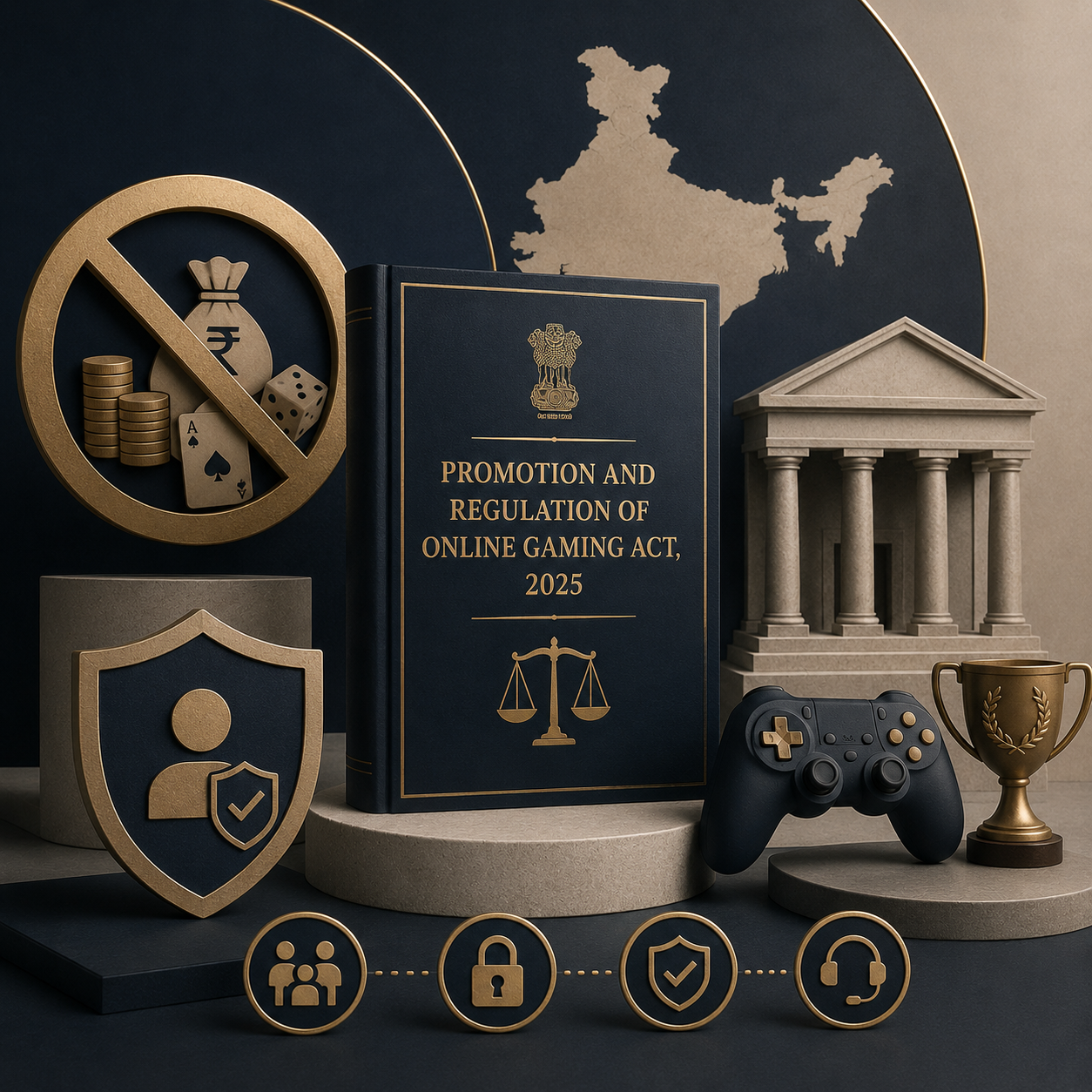
The online gaming sector in India has entered a new regulatory era with the enactment of the Promotion and Regulation of Online Gaming Act,2025 and the notification of the rules framed thereunder. Notified by the Ministry of Electronics and Information Technology (MeitY) and brought into force on 1 May 2026, the legislation represents India’s first comprehensive statutory framework dedicated exclusively to the regulation of online gaming. The Act introduces a structured regulatory regime for the sector, classifies online games into distinct categories, establishes a dedicated regulatory authority, and seeks to address concerns relating to online money gaming through a prohibition-based approach.
Objectives of the Act
The primary objective of PROGA is to prohibit the offering, operation, facilitation, promotion, advertisement, and participation in online money games while simultaneously promoting legitimate online social games and e-sports. The Act seeks to protect individuals, particularly youth and vulnerable groups, from the social, economic, psychological, and privacy-related harms associated with online money gaming. It also aims to ensure responsible use of digital technologies and establish a uniform regulatory mechanism applicable throughout India, including platforms operating from foreign jurisdictions but accessible to Indian users.
The Act consists of nineteen sections distributed across six chapters and is supplemented by the Online Gaming Rules, 2026, which provide detailed procedures relating to registration, classification, enforcement, grievance redressal, and compliance requirements.
Establishment of the Online Gaming Authority of India
Section 8 of PROGA authorises the Central Government to establish the Online Gaming Authority of India as the principal regulatory body. The composition of the Authority is further detailed under Rule 6 of the Online Gaming Rules, 2026.
The Authority is headed by a Chairperson in the rank of Additional Secretary, Ministry of Electronics and Information Technology, and comprises representatives from the Ministries of Information and Broadcasting, Youth Affairs and Sports, and Financial Services. Additionally, two members not below the rank of Director are appointed, with at least one possessing expertise in law. A Secretary to the Authority is also appointed by the Central Government.
The Authority possesses extensive powers under Rule 10. These include determining whether a game qualifies as an online money game, recognising and registering online social games and e-sports, maintaining national registries, investigating complaints, issuing directions to gaming service providers, imposing penalties, suspending registrations, and hearing appeals. Further, the Authority enjoys powers equivalent to those of a civil court, including summoning witnesses, receiving evidence, and compelling the production of documents.
Classification and Registration of Online Games
The Act classifies online games into three categories: online social games, e-sports, and online money games.
Section 2 (i) defines online social games as a game that does not involve staking money or participating with an expectation of monetary gain. Such games may charge subscription fees or one-time access fees, provided these payments do not constitute wagers. They are intended solely for entertainment, recreation, or skill development.
Section 2 (c) defines E-sports as competitive games played individually or in teams under predetermined rules, where outcomes depend on strategic thinking, physical or mental agility, and similar skills. Importantly, e-sports cannot involve wagers, bets, or monetary stakes, although registration or participation fees may be charged to cover administrative expenses. However, the Act expressly provides that an e-sport cannot be classified as an online money game.
Online money games are defined in Section 2(j) as any online game that a user plays by paying fees, depositing money or other stakes in anticipation of winning, which entails monetary and other enrichment in return of money or other stakes, regardless of whether the game is based on skill, chance, or both; however, this definition excludes e-sports.
Historically, Indian law distinguished between games of skill and games of chance, permitting real-money skill-based platforms like Dream11 to operate legally. However, the new regulatory framework largely renders this distinction irrelevant by prohibiting online money games based on the presence of monetary stakes and rewards, thereby requiring even leading skill-gaming platforms to discontinue their real-money gaming operations.
Under Part IV of the Rules, gaming service providers may apply to the Authority for recognition and registration. The Authority evaluates applications by examining factors such as the game’s revenue model, user safety measures, grievance redressal systems, intended age groups, and the existence of monetary stakes. Upon satisfying the prescribed requirements, the Authority may grant registration within ninety days.
Prohibitions and Penalties
One of the most significant aspects of PROGA is its strict prohibition of online money gaming. Section 5 prohibits any person from offering, facilitating, inducing, or engaging in online money gaming services. Section 6 prohibits advertisements that directly or indirectly promote online money games. Section 7 further prohibits banks, financial institutions, and payment intermediaries from facilitating transactions connected with online money gaming services.
The Act prescribes stringent penalties for violations under section 9 of the act. Section 9 (1) provides that offering online money gaming services may attract imprisonment of up to three years and a fine of up to one crore rupees. Advertising online money games may result in imprisonment of up to two years and fines up to fifty lakh rupees as provided under section 9(3). Additionally, Section 9 (4) provides that the financial institutions facilitating prohibited transactions may also face imprisonment up to three years and fines up to one crore rupees.
Criticisms
Industry stakeholders argue that the legislation treats legitimate skill-based gaming platforms and unlawful gambling operators alike, potentially affecting an industry that has attracted substantial foreign investment and generated significant employment. Critics further contend that less restrictive regulatory measures, such as age verification, deposit limits, and restricted gaming hours, could achieve consumer protection objectives without imposing an extensive prohibition. Constitutional concerns have also been raised regarding the Act’s compatibility with principles of proportionality and the traditional allocation of gambling regulation to the States. The challenges are pending before the supreme court alleging the act to be violative of Article19 (1)(g).
Conclusion
The Promotion and Regulation of Online Gaming Act, 2025, together with the Online Gaming Rules, 2026, marks a significant shift towards a centralized regulatory framework for online gaming in India. However, its prohibition-based approach remains contentious. Reports suggest that the proportion of Indian gamers using unregulated offshore platforms rose from 3.4% before the ban to 44% afterwards, indicating that prohibition may push users towards platforms beyond Indian regulatory control. The 276th Law Commission Report (2018) similarly cautioned that blanket bans are difficult to enforce and often foster illegal markets, black money, and corruption, advocating regulation instead of prohibition. Consequently, the long-term success of PROGA will depend on whether its restrictive approach can effectively achieve its objectives or whether a balanced regulatory model would better serve both consumer protection and industry growth.
Disclaimer: The views expressed herein are solely for legal research purposes and do not constitute legal opinion, legal advice, solicitation, or professional guidance of any nature. The views are personal to the author and do not necessarily reflect those of PJ Law Offices (www.pjlaw.in), its principal, representatives, associates, retainers, affiliates (collectively, “PJLaw”). Readers are advised to seek independent legal counsel before acting on any information contained herein. PJLaw makes no representation or warranty, express or implied, regarding the accuracy or completeness of the contents and expressly disclaims all liability arising from reliance upon or use of the same.