SEBI Notifies Buy-Back Amendments, 2026: Open Market Buy-Backs Return from 01 August 2026
SEBI has notified the Securities and Exchange Board of India (Buy-Back of Securities) (Amendment) Regulations, 2026, bringing into effect the proposals discussed in its April and May 2026 consultation papers. The amendments will come into force on 1 August 2026.
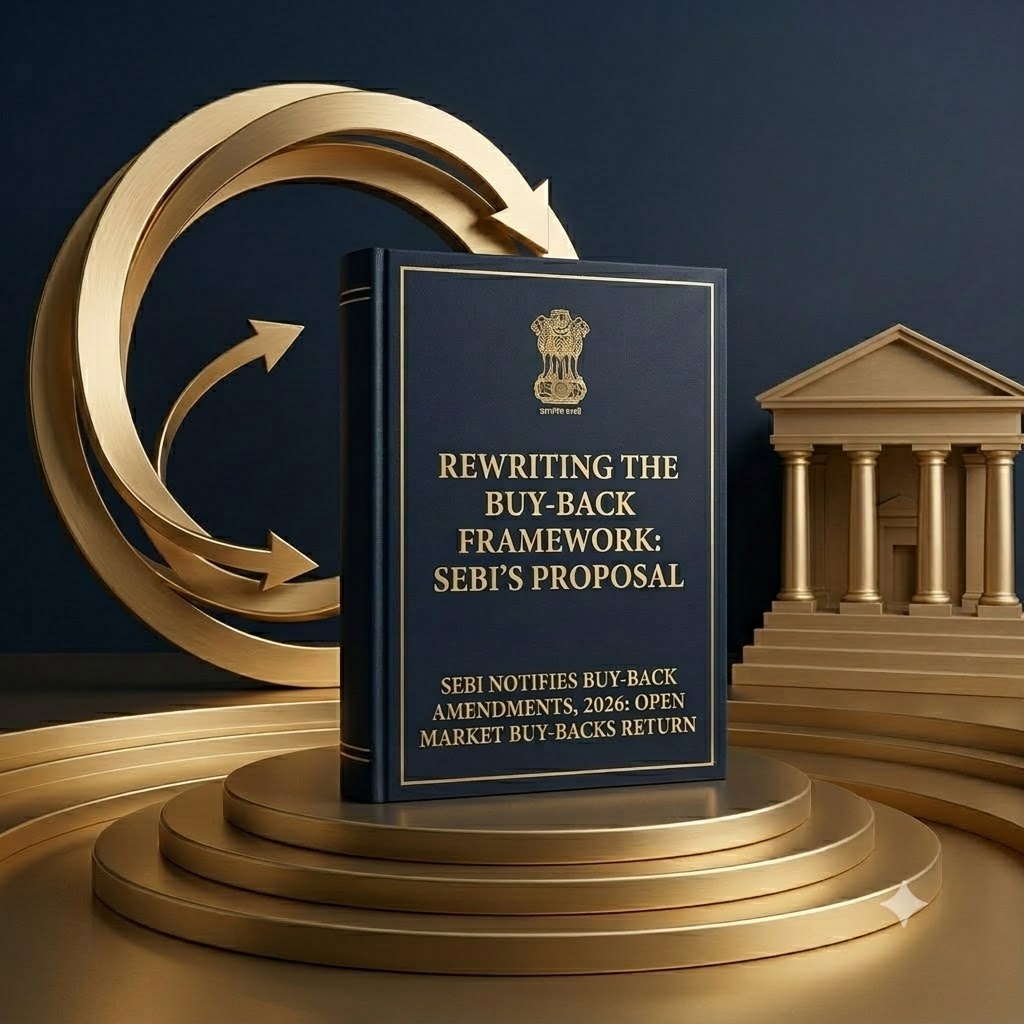
As discussed in our earlier article, Rewriting the Buy-Back Framework: SEBI’s Proposal to Restore Open Market Buy-Backs, SEBI had proposed to reintroduce the open market buy-back mechanism in light of the revised taxation framework. The notified amendments largely adopt the consultation proposals, with one notable exception.
Key Amendments
- Reintroduction of open market buy-backs through the stock exchange: Listed companies can once again undertake buy-backs through the stock exchange route, in addition to the existing tender offer mechanism. Open market buy-backs will be permitted up to 15% of the paid-up capital and free reserves, computed on the lower of the standalone or consolidated financial statements. This restores a capital allocation tool that had been phased out from April 2025 following concerns around shareholder equality and the then prevailing tax regime.
- Execution through the normal trading window: SEBI has dispensed with the requirement of a separate trading window for open market buy-backs. Buy-back transactions will now be executed through the normal trading mechanism, and companies will no longer be identified as purchasers on the trading screen. This reflects the changed tax treatment of buy-backs, which removed the primary rationale for maintaining a dedicated window.
- Enhanced shareholder communication: Companies undertaking an open market buy-back must now electronically intimate shareholders (holding shares as on the date of the public announcement) within one working day of the public announcement. This is intended to supplement exchange disclosures by ensuring timely and direct communication to shareholders.
- Time-bound completion: SEBI has retained the requirement that open market buy-backs be completed within 66 working days from the opening of the offer, while continuing the requirement that at least 40% of the buy-back size be utilised during the first half of the offer period. In doing so, SEBI declined the PMAC’s recommendation to restore the earlier six-month timeline.
- Additional safeguards: The amendments also:
- align the cooling-off period between successive buy-backs with the Companies Act, 2013;
- prohibit buy-backs that would result in a breach of minimum public shareholding requirements; and
- strengthen restrictions on promoter participation during open market buy-backs, including freezing promoter holdings during the buy-back period.
What Did Not Make It into the Final Regulations?
The most significant departure from the consultation papers relates to the mandatory appointment of a Merchant Banker.
SEBI had proposed making the appointment optional and redistributing several merchant banker functions including certain filing, due diligence and escrow-related responsibilities to companies, stock exchanges and secretarial auditors as part of its ease-of-doing-business initiative. However, the proposal received mixed stakeholder feedback and did not find place in the final regulations. Accordingly, the existing framework requiring the appointment of a Merchant Banker for buy-backs continues unchanged.
Consequently, the proposed reallocation of merchant banker functions has also not been implemented. Likewise, certain operational aspects discussed in the Board Memorandum such as permitting invocation of encumbrances during the promoter freeze subject to continuation of the freeze in the transferee’s account have not been codified in the Amendment Regulations and may instead be addressed through future SEBI circulars.
Conclusion
The notified amendments substantially reflect SEBI’s consultation proposals and complete the regulatory reversal initiated after the overhaul of the buy-back taxation framework. While the reintroduction of the stock exchange route enhances flexibility for listed companies, SEBI has consciously retained key intermediaries and safeguards, signalling a calibrated approach that balances ease of doing business with regulatory oversight.
Disclaimer: The views expressed herein are solely for legal research purposes and do not constitute legal opinion, legal advice, solicitation, or professional guidance of any nature. The views are personal to the author and do not necessarily reflect those of PJ Law Offices (www.pjlaw.in), its principal, representatives, associates, retainers, affiliates (collectively, “PJLaw”). Readers are advised to seek independent legal counsel before acting on any information contained herein. PJLaw makes no representation or warranty, express or implied, regarding the accuracy or completeness of the contents and expressly disclaims all liability arising from reliance upon or use of the same.