RBI’s Message to MFIs and NBFCs: Suspicious Transactions Cannot Go Unnoticed
RBI has penalised CreditAccess Grameen Limited for a gap that many NBFCs and MFIs overlook which is not having software that raises an alarm when a customer’s transactions don’t match their risk profile under Know Your Customer (KYC) requirements.
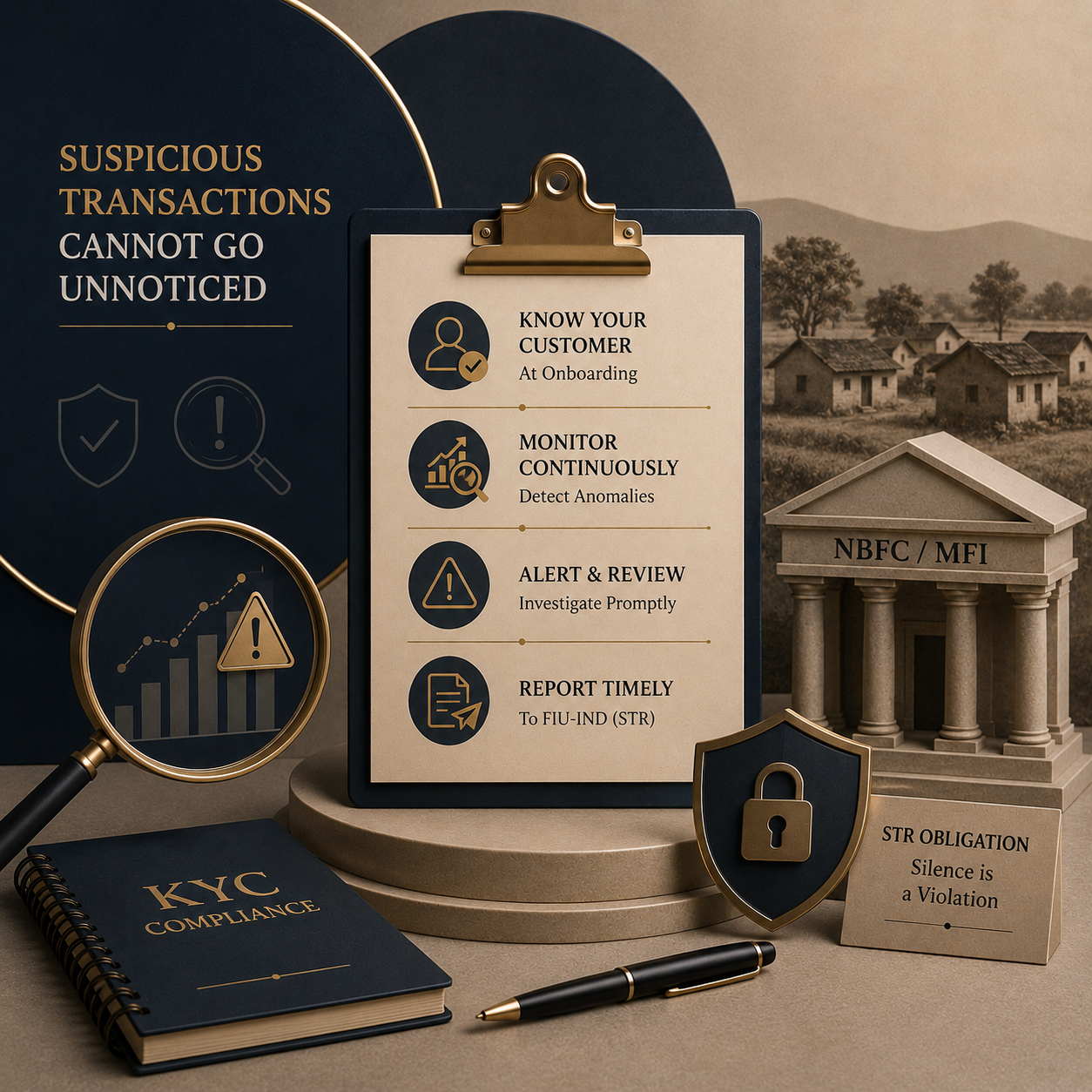
The action serves as a timely reminder that KYC is not merely about collecting customer documents but it is equally about continuously monitoring customer transactions and reporting suspicious activities.
Under the RBI’s Know Your Customer Directions, 2025, NBFCs and MFIs are required to furnish prescribed reports, including Suspicious Transaction Reports (STRs), to the Financial Intelligence Unit-India (FIU-IND). More importantly, Paragraph 53 mandates institutions to implement robust software that generates alerts whenever customer transactions appear inconsistent with the customer’s risk profile or updated business and financial profile.
What Went Wrong?
The RBI observed that the institution lacked an effective system capable of identifying unusual transactions and generating timely alerts. This weakened its ability to detect and report suspicious transactions, a critical component of the anti-money laundering framework.
Why Does This Matter?
Consider a simple example:
A borrower classified as a low-risk rural customer regularly repays a monthly instalment of ₹2,000. Suddenly, multiple high-value transactions begin flowing through the customer’s account that are unrelated to the customer’s known profile or source of income.
Your loan officer may not notice. But your software should. If it doesn’t? That’s exactly the violation RBI just penalised. No STR is filed. The NBFC’s system simply has no mechanism to flag the mismatch. Under RBI’s NBFC KYC Directions 2025, this silence is itself a compliance failure.
A robust monitoring system should immediately flag such activity for review. If the institution fails to detect the anomaly, it may miss potential indicators of money laundering, fraud, or other illicit activities.
RBI’s Expectation
This connects directly to the Suspicious Transaction Report (STR) obligation under the PMLA rules. FIU-IND relies on your system’s intelligence to catch what human eyes miss. Every day of delay in reporting a suspicious transaction counts as a separate violation. There is no grace period for silence.
For MFIs and NBFCs serving large rural or semi-urban populations at scale, where thousands of transactions occur daily, manual monitoring is simply not viable. The regulation acknowledges this reality and demands a technological answer.
Key Takeaway
The lesson from this enforcement action is clear: KYC compliance does not end at onboarding. Institutions must “Know Your Customer” throughout the customer relationship. Technology-driven monitoring, timely escalation of alerts, and prompt reporting to FIU-IND are no longer optional compliance practices—they are regulatory expectations.
For MFIs and NBFCs, investing in effective transaction monitoring systems today can prevent regulatory penalties tomorrow and strengthen the integrity of the financial system as a whole.
More information is available here