
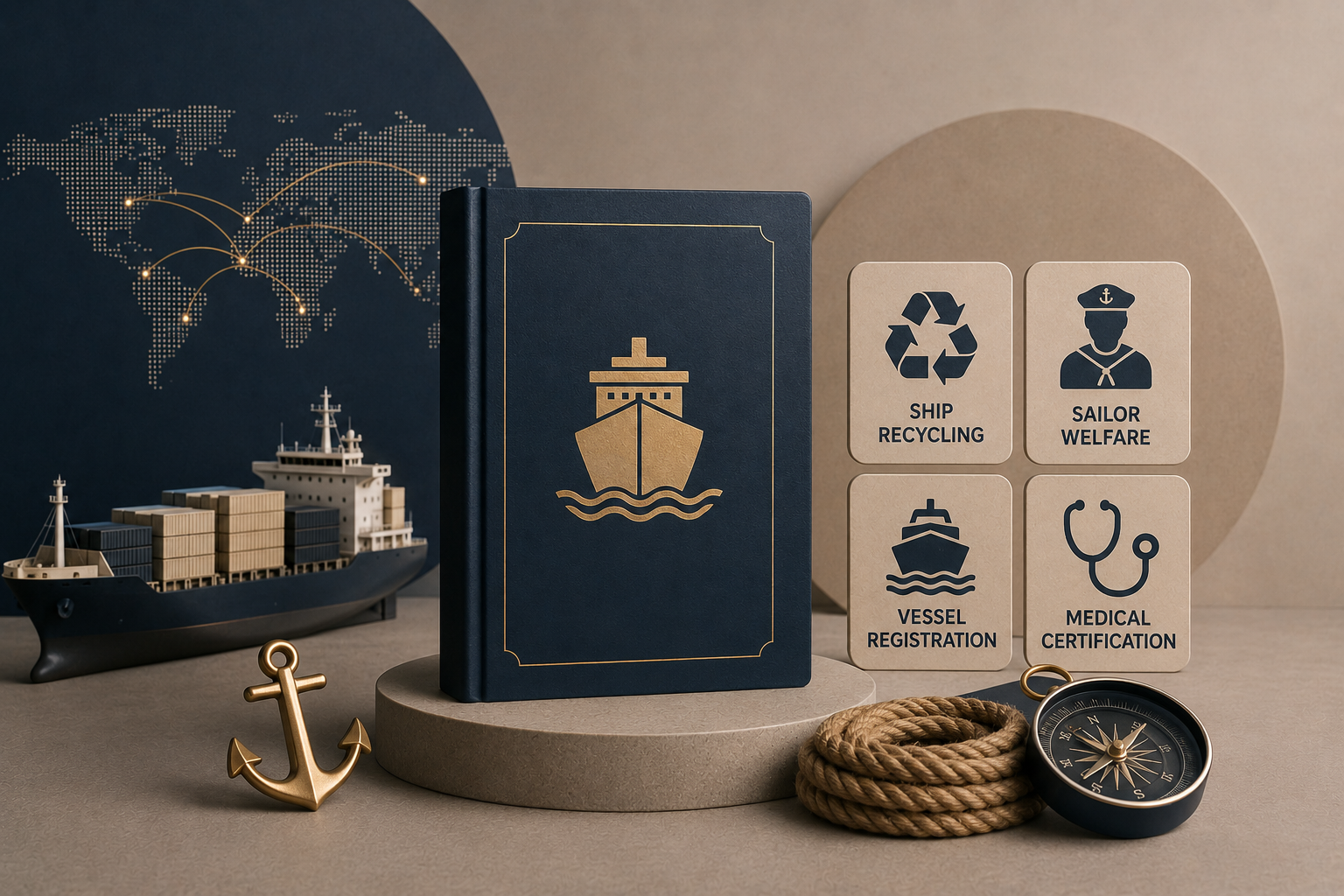
India’s Maritime Upgrade: Four New Modules Reshaping the Shipping Sector
India’s maritime sector has long punched below its weight for a country with over 7,500 kilometres of coastline and one of the largest seafaring workforces in the world. As part of a ₹70,000 crore maritime development package announced in 2025, the Government has rolled out four digital modules targeting ship recycling, sailor welfare, vessel registration, and medical certification.The launch comes shortly after the entry into force of the Hong Kong International Convention for the Safe and Environmentally Sound Recycling of Ships (HKC) in June 2025. Adopted by the International Maritime Organization (IMO) in 2009, the Convention took nearly sixteen years to become operational due to its stringent ratification requirements, which mandated support from a minimum number of States representing substantial portions of the world’s merchant fleet and ship recycling capacity. Against this backdrop, the new modules reflect a broader effort to align India’s maritime governance framework with evolving international standards while strengthening domestic shipping, shipbuilding, and seafarer welfare infrastructure.
Turning Scrap into Shipbuilding: The Recycling Credit Scheme
The most commercially significant of the new launches is the Unified Ship Recycling Credit Note Module. Under the Ship Recycling Credit Scheme, ship owners who recycle their vessels at Indian yards certified under the Hong Kong Convention (HKC) receive a credit note worth 40% of the vessel’s scrap value, redeemable against new shipbuilding orders placed in India. The incentive is well designed: it does not hand over cash, but redirects value back into the domestic industry.
The Hong Kong International Convention for the Safe and Environmentally Sound Recycling of Ships entered into force in June 2025 after years of delayed ratification. An IMO instrument, the HKC requires ships of 500 GT and above to maintain an Inventory of Hazardous Materials (IHM) and to be broken down only at authorised recycling facilities. India’s Alang yards in Gujarat, the world’s largest ship recycling destination by volume, have been working toward HKC compliance and this scheme gives ship owners a clear financial reason to choose compliant Indian yards over cheaper but less regulated alternatives elsewhere.
The policy logic is circular in the best sense: old ships, responsibly dismantled, generate credits that fund new ships built in India. For a country that currently imports the bulk of its shipping tonnage, this is a meaningful step toward building a self sustaining maritime value chain.
Seafarer Welfare: Making the MLC More Than a Promise
India has over two lakh seafarers working on vessels across the world, often in conditions far removed from any domestic legal oversight. When disputes arise over wages, working conditions, or treatment on board the practical barriers to raising a complaint have been considerable. The new 24×7 Grievance Redressal Module under the e-Navik portal is designed to close that gap.
Sailors can now file grievances through the e-Navik portal, WhatsApp, a toll free helpline, or email regardless of where they are in the world. The module is framed as part of India’s commitment to the Maritime Labour Convention, 2006 (MLC), an IMO instrument that sets minimum global standards for seafarers rights and requires flag states to maintain accessible grievance mechanisms. India’s implementation of this module signals that these obligations are being taken operationally seriously, not just endorsed on paper.
e-Samudra: Making the Indian Flag Competitive
A persistent structural problem for India’s shipping sector has been the preference among Indian ship owners to register their vessels under foreign flags. Panama, Liberia, and the Marshall Islands being the most popular. The reasons are straightforward: faster processing, lower compliance costs, and simpler documentation. The result is that India, despite being a major maritime nation by geography and workforce, has a relatively small fleet registered under its own flag.
The Ship Registration Module under e-Samudra directly addresses this by digitising and streamlining India’s vessel registration procedures. The objective is to make the Indian flag administratively competitive, reducing the friction that has historically pushed owners toward flags of convenience. A larger Indian flagged fleet has downstream benefits: greater cabotage leverage, improved maritime insurance market depth, and stronger standing in IMO deliberations.
Medical Certification: Closing a Quiet Loophole
Before any sailor can serve on a vessel, they must hold a valid medical fitness certificate issued by an authorised doctor. In practice, oversight of this certification process has been weak, leaving room for negligent or outright fraudulent certifications, a safety concern with serious consequences when it fails mid-voyage.
The Medical Practitioner Module creates a centralised register of doctors approved to certify seafarers, enabling ongoing monitoring of their certifications. It is not a dramatic reform, but it addresses a compliance gap that has operated with insufficient scrutiny for too long.
A Sector in Motion
None of these modules is individually transformative. What matters is that they address real, well-documented problems in the sector rather than serving as performative digitalisation. The recycling credit scheme links environmental compliance to industrial incentive. The e-Navik module converts treaty obligations into operational infrastructure. e-Samudra tackles flag competitiveness at its administrative root. And the medical module brings accountability to a process that directly affects safety at sea.
India’s stated ambition is to rank among the world’s leading shipbuilding nations by 2030. Achieving that will require more than capital it will require the kind of institutional credibility that comes from getting the fundamentals right. These four modules are a step in that direction.
Disclaimer: The views expressed herein are solely for legal research purposes and do not constitute legal opinion, legal advice, solicitation, or professional guidance of any nature. The views are personal to the author and do not necessarily reflect those of PJ Law Offices (www.pjlaw.in), its principal, representatives, associates, retainers, affiliates (collectively, “PJLaw”). Readers are advised to seek independent legal counsel before acting on any information contained herein. PJLaw makes no representation or warranty, express or implied, regarding the accuracy or completeness of the contents and expressly disclaims all liability arising from reliance upon or use of the same.